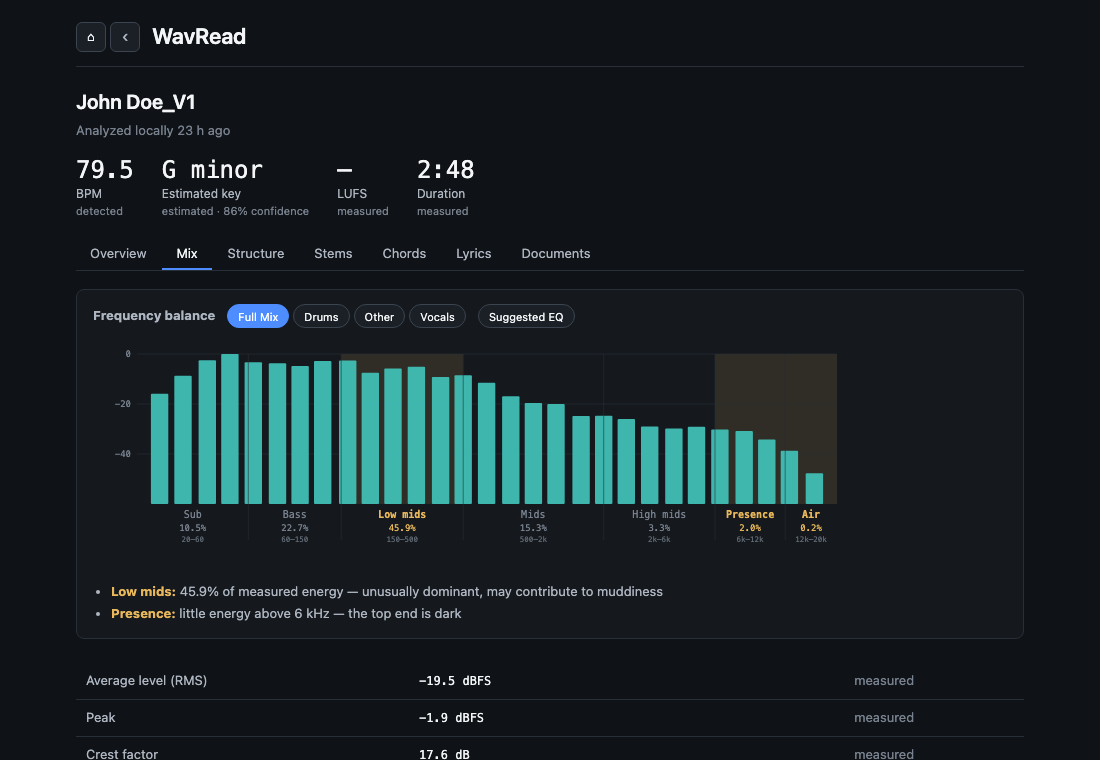
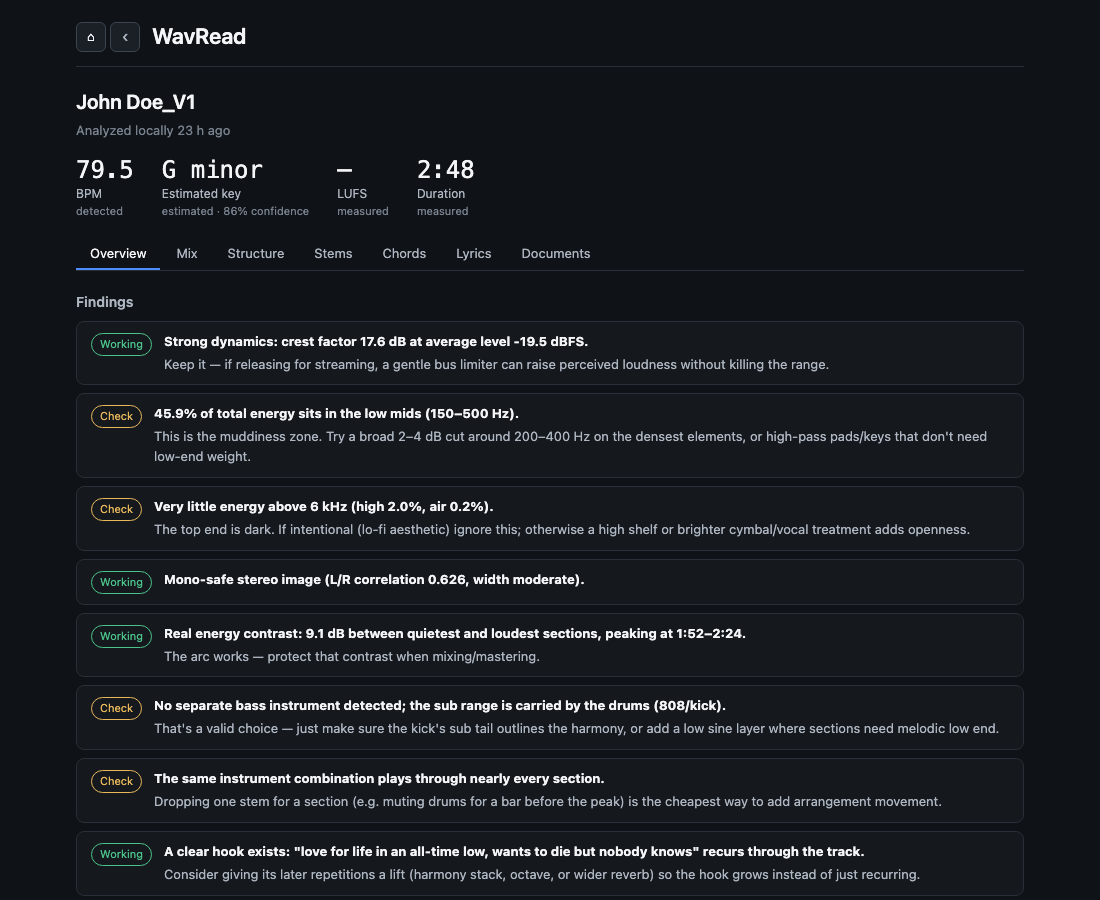
A real analysis. The low mids are flagged because they measure 45.9% of the
track's energy — WavRead says what it found and why it matters.
Everything stays on your computer
Your music is never uploaded — there are no WavRead servers to upload it to.
No account, no telemetry, no identifier. Four requests exist in the whole app:
a daily version check you can switch off, an update you asked for, and the two
model downloads you only trigger by using separation or lyrics.
Drop in a finished track, a folder of stems, or capture a session straight
from your DAW. WavRead measures tempo, key, loudness, dynamics, frequency
balance, stereo image and structure on this computer, estimates the chords,
melody and lyrics, and writes two documents: everything measured, and what it
may mean.
Every number is labelled for what it is — measured,
detected, estimated, or
unavailable. WavRead never claims more certainty than the
analysis allows.
Every number is labelled for what it is — detected, estimated with confidence,
or measured. Findings say what's working and what to look at.
Give it to any AI — optionally
AI assistants can't hear audio, but they can read. The Track Document contains everything
an assistant needs to give deep, specific advice about your mix and arrangement — paste it
into Claude, ChatGPT, or anything else. WavRead itself never requires AI: the built-in
Feedback Report works completely offline.
Compare tracks
Put your mix next to a reference track — or next to last week's version of the same song —
and WavRead reports the measured differences in plain language: loudness, dynamics, frequency
balance, stereo width. Context decides whether a difference is good; WavRead just makes it visible.
Built on
WavRead is a commercial product built on excellent open research. These components
keep their own licences, reproduced in full in the THIRD_PARTY_LICENSES file
that ships with the app.
WavRead is free to use today, at version 1.4.11. It will become a paid app — a
one-time purchase, not a subscription, since it runs on your computer and
there is nothing for us to host.
That change is not tied to a version number. It happens when the app is code-signed and
notarized, because a paid download should not warn you about an unidentified developer on
first launch. Signing needs an Apple Developer account, which isn't in place yet. You'll be
told before anything starts costing money.
The installer isn't code-signed yet, so on first launch macOS will warn about an
unidentified developer: right-click the app → Open → Open, once. Code
signing is planned. Analyses made under the app's former name, SoundScribe, keep working.
Development status
1.4.11 — August 16, 2026
A large capture no longer splits into separate analyses: thirty-one plugin instances joining at once were overwriting each other's entries in the session file, and could leave it unreadable
Sessions damaged by the earlier versions are recovered rather than discarded, so a capture recorded before this fix is not lost
1.4.10 — August 16, 2026
The capture plugin now knows what it is on — a track, a group or stack, a reverb bus, a delay bus, or the master — and each one is analysed differently
Capture a reverb or delay return on its own bus and its decay and repeat times are measured on the effect itself, not inferred from what the master has left over
Captures are put on one timeline: a host does not run a track's plugins until that track has audio, so parts that enter later are aligned before analysis rather than treated as though they opened the song
Takes are named from what they contain instead of all being called "Session", and any analysed track can be renamed afterwards — documents, audio, markers and history move together
The stem table gained level against the loudest part, a reduce-by column, per-part crest, and DC offset with asymmetry, so a DC offset on the master can be traced to the part causing it
Key detection asks the chord progression which note is the tonic, correcting the relative-major error; stem separation is cached against a hash of the audio rather than a filename
1.4.4 — August 16, 2026
Capture a session straight from your DAW with the WavRead Bridge plugin (AU and VST3): the master, the parts, or both — armed together in one press
Capture the master alongside the parts and WavRead measures what the master bus adds: delay times, how long the reverb takes to decay, and the tone change through the bus
Every part is now measured for peak, true peak and clipping, so a track that arrived already clipped is named rather than hidden in the mix
How to use WavRead is now a page inside the app, and Update now installs a release after checking it against its published checksum
1.4.0 — August 15, 2026
Findings you can check: every finding that can be heard carries a Listen button that plays and loops exactly the range it stands on, and opens the graph it came from
A finding is now three separable parts — the measurement, what it may mean, and what to listen for. Processing recipes are gone: WavRead measures, your DAW edits
Stems are named as the source of a frequency band only when the data supports it, and never when the energy is spread across parts
1.3.0 — August 15, 2026
Measurement trust: peak was being measured on the mono fold-down, which hides a peak living in one channel by up to 6 dB — now measured on the real channels. Reanalyze in Settings to correct existing tracks
True peak (dBTP) by oversampling per ITU-R BS.1770, plus loudness range (LRA), peak-to-loudness, per-channel peaks, clipping count and DC offset
A delivery contract in every document, each value naming the standard it was measured to and the versions that produced it
Loudness points now sit at their real measurement positions rather than spread across the track
Values that could not be measured say so instead of showing a dash
1.2.1 — August 15, 2026
Mono switch: hear the mix summed to mono, so mono-compatibility findings can be listened to rather than only read
Skip ten seconds back and forward on the transport
Mix history: group mixes of one song as versions, note each, and see what the measurements did between them
Update checks that tell you a new version exists and never install anything
Fixed: “Hear the difference” did nothing until playback had started, and “Play this section” ran past the end of the section
1.2.0 — August 15, 2026
Listening markers: mark a moment while the track plays, write what you noticed, and see what the measurements say differs around it — loudness, activity, stereo width and correlation against the track and the section it falls in
Markers are written into the Track Document, so the copy, the downloads and the AI handoff carry your notes beside the measurements
Notes are stored outside the analysis, so reanalysis never destroys them
1.1.0 — August 14, 2026
Suggested EQ you can hear: an A/B during playback that compares your track flat against the suggested curve, level-matched so the comparison is not won by loudness. It previews the suggestion — nothing is written, exported, or altered, and playback always starts flat
The drawn curve is now the real response of the filters being played
First stable release; supersedes the 1.0.0-rc series
1.0.0-rc3 — August 14, 2026
Persistent player with waveform seeking, section looping, and stem soloing from the frequency graph
1.0.0-rc2 — August 14, 2026
Time-based analysis: loudness and stereo-width timelines, mono-compatibility ranges, and section-to-section comparison
1.0.0-rc1 — August 14, 2026
Stabilization candidate: accessibility pass (landmarks, skip link, heading outline), first-run introduction, offline resilience for the model-backed stages, and real screenshots on this page. Not the 1.0 launch — signing and licensing still pending
0.9.3 — August 14, 2026
Live per-second analysis timer, cleaner header, and a clear message when macOS blocks folder access
0.9.2 — August 14, 2026
Analysis provenance and reanalysis, local storage dashboard with scoped deletion, real navigation, library search/sort, and cancellable analyses
0.9.1 — August 13, 2026
Real-session stem fixes: sparse stems (adlibs, risers, chops) are no longer treated as silence; lyrics find the actual vocal stem
0.9.0 — August 13, 2026
Pluggable stem separation: bring your own stems, or point WavRead at a separation tool you already have; analysis no longer requires a separation backend
0.8.0 — August 13, 2026
Suggested EQ ghost curve ("consider testing…" — suggestions, never corrections) and polished comparisons with LU deltas and per-region differences
Playback and batch fixes: drops outside the zone no longer strand you, multi-track analysis queues reliably, Copy no longer interrupts playback, smoother pause/resume
0.6.1 — August 13, 2026
Playback-linked spectrum: live animation over the average reference, with a section-aware timeline cursor
0.6.0 — August 13, 2026
Frequency Balance graph: 1/3-octave spectrum with readable regions and plain-language findings, in the app and in exports
0.5.2 — August 13, 2026
Analysis timer; simplified single Copy button
0.5.1 — August 13, 2026
Stability fixes from first-day beta testing: no more ghost window during analysis, exports save to Downloads, in-app JSON viewer, readable errors with a local log, quit-confirmation mid-analysis, app icon
0.5.0 — August 13, 2026
Product renamed from SoundScribe to WavRead; existing analysis files remain readable
New design system across the app, website, and exported documents